
Demystifying Progressive Overload
A Guide to Training Progression Methods by Proxima Fitness: Build Custom Programs for Hevy and MacroFactor Workouts

Progressive Overload is simple
Progressive overload is just the process of doing more over time to force your body to adapt. Whether that be more reps, more weight, more intensity or less rest time, each method is a strategy to increase your work output. Muscles respond to the stimulus you provide them. The more stimulus you provide, the more they will be forced to adapt.
Fitness apps and online coaches often market proprietary algorithms and deep AI analysis to make you feel like you can’t make progress without a subscription. By making progression seem like a complex math problem, apps create a dependency where the user feels like they are paying for a secret formula rather than just tracking their own hard work.
The truth is that your muscles don’t know what an algorithm is, they only know that the weight today was heavier than the weight last week. The objective is not to deter you from your favourite fitness app, it is to give you the ability to understand and interpret your own training data. In this article I hope to demystify the concept of Progressive Overload, so that you can pick what works best for you.
Linear Progression (The Beginners Method)
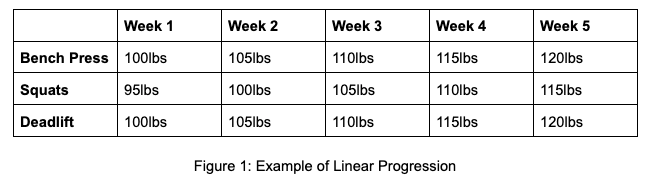
The Method: Add a fixed amount of weight (e.g. +5lbs) to the bar every single session for the same number of sets and reps.
This method is mainly useful to beginners because it becomes impossible to add weight every session at higher experience levels. It allows beginners to develop a solid strength base. Eventually, this training method should be swapped out for one of the latter progression systems in this article.
Pros
Simple and easy to follow
Ideal for beginners
Starts as the foundation for strength and mass building
Cons
Progress may stall quite fast, especially for more experienced lifters
Minimal training variety can lead to boredom and burnout
Suboptimal for targeting specific individuals needs or lagging areas
Best Linear Progression Programs (Free)
r/Fitness Basic Beginner Routine: A popular 3x5 routine made by the r/Fitness subreddit
Phrak’s Greyskull LP: Beginner split with a balance of push and pull movements
GZCL Program: Cody Lefever’s famous linear progression program for beginners
nSuns 531: The most popular intermediate powerbuilding program on the internet
Reddit PPL: Push Pull Legs hypertrophy program for novice and intermediate lifters
Double Progression (The Gold Standard)
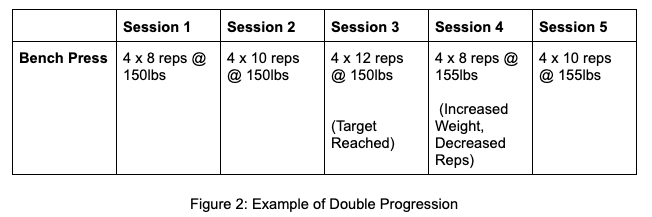
The Method: Using a rep range (e.g. 8-12 reps), increase reps until maximum of rep range has been hit, then increase the weight.
The process of using a Double Progression method is still very simple. We start by selecting a rep range for our exercise (e.g. 4 sets of 8-12 reps for Bench Press). Next we pick a starting weight (e.g. 100lbs). Then we attempt to complete 4 sets of 8 reps at 100lb. If we hit 4 sets of 8 reps, then next session we will aim for 4 sets of 9 reps and work our way up until we are capable of doing 4x12@100lbs. When we hit this milestone, we drop back to a 4x8 and increase the weight by our increment (e.g. +5lbs). Rinse and repeat.
Pros
Good for encouraging strength and endurance improvements
Helps target specific weaknesses and sticking points
Plateau buster
Cons
Takes a little longer to grasp than Linear Progression
Requires more time tracking progress
May not be suitable for absolute beginners
Best Double Progression Programs (Free)
Intermediate PPL: A popular hypertrophy program from the Proxima Fitness community
4x /wk Hypertrophy Program: Currently the highest rated program on the platform
Wave Progression (Fatigue Manager)
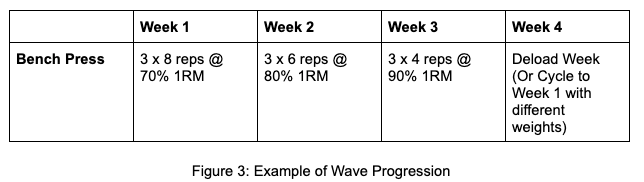
The Method: Cycle through periods of increasing and decreasing intensity.
This method allows for periods of higher loads followed by lighter loads, to facilitate recovery and adaptation. Wave progression is particularly useful for intermediate and advanced lifters who have plateaued. It also helps with fatigue management.
Definition: 1RM = 1 Repetition Maximum (e.g. If your 1RM is 100lbs for Bench, then your 70% 1RM is 70lbs)
Pros
Helps significantly with recovery as it allows for periods of varied volume
Prevents plateaus that arise from consistent weight increases
Potentially better long term progress due to better stress management on the body
Cons
No clear North Star objective
May take longer to see significant growth/strength improvements
Not ideal for beginners
Best Wave Progression Programs (Free)
Candito 6-week strength: Break PRs with this intense and fun 6-week powerlifting split
5/3/1 for Beginners: Wendler’s famous 5/3/1 strength training philosophy for beginners
5/3/1 Boring But Big: Popular 5/3/1 variation to build strength and size for intermediates
Step Loading Progression (Owning the weight)
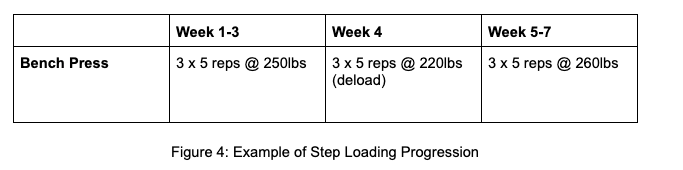
The Method: Keep the weight and reps the same for several weeks (building “density” and proficiency), then take a large “step” up in weight all at once.
Think of Step Loading as a staircase rather than a ramp. You stay at one “step” (weight) for a set period, integrating specific rep schemes and rest intervals, before climbing to the next level. This method emphasizes quality of adaptation over speed, providing the extra recovery time that high-level lifters need to handle heavy iron safely.
Pros
Delaying weight increases allows your body to “own the weight” before increasing
Adequate recovery before pushing harder
More suitable for intermediate to advanced lifters
Cons
Typically slower progress than other methods, or progress goes unnoticed until the step is attempted
Less effective for beginners who can progress more quickly
Requires more patience and dedication
RPE-based Training (Training based on feel)
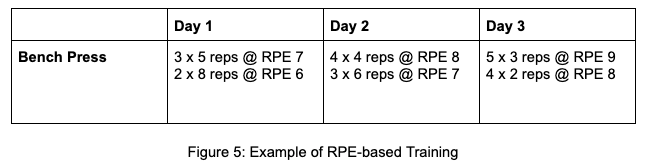
The Method: Rate how hard a set was on a scale of 1-10 (10 being hardest) and adjust your reps/weights to reflect the target during the session.
RPE (Rate of Perceived Exertion) is a subjective measure of training intensity. RPE-based progression involves adjusting training loads based on how difficult a set feels rather than following a strict percentage-based program. This method allows for more flexibility and individualization in training, accounting for daily fluctuations in performance and recovery.
Pros
Tailors training to the individual
Accounts for daily fluctuations in performance and recovery
Can lead to more sustainable long term gains if trained correctly
Cons
Requires accurate self-assessment
Often considered too subjective
Not suitable for beginners
Undulating Periodization (Preventing Stagnation)
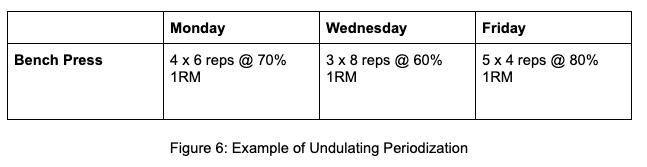
The Method: Instead of changing weight or reps every few weeks, you change them every workout (Daily Undulating Periodization - DUP) or every week (Weekly Undulating Periodization - WUP).
This method helps prevent stagnation and keeps the training stimulus fresh. You can change any of your training variables to vary the volume and keep your training entertaining.
Pros
Provides variety in training, reducing the potential for boredom or burnout
Can lead to better long term progress
Can prevent getting stuck at a certain weight
More effective at addressing specific weaknesses
Cons
Requires careful planning
Harder to tell if you’re progressing
Not ideal for beginners
Block Periodization (Strength block, Hypertrophy block, Power block)
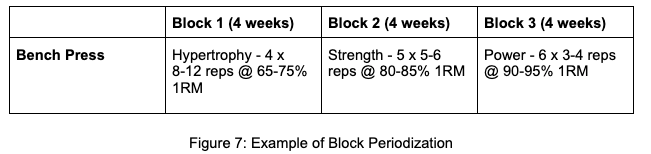
The Method: Dividing your training into specific “blocks” (usually 4–8 weeks each), where each block focuses on a single goal.
Each block focuses on developing particular aspects of fitness, such as strength, hypertrophy, or power, and builds upon the progress made in the previous block.
Pros
Allocate the required time to improve in each specific area
Can lead to greater long term progress
Allows for better recovery and stress management
Cons
Requires significant long term planning
Not suitable for beginners
Program variables need to be intelligently selected
Auto-Regulation (The Readiness Score)
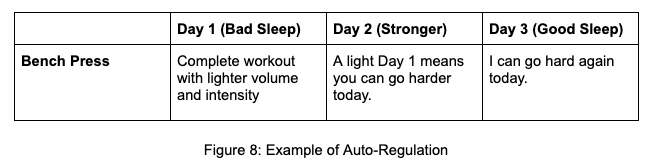
The Method: Using subjective scales like RPE (Rate of Perceived Exertion) or RIR (Reps in Reserve) to adjust your weights in real-time based on how you feel that day.
Similar to the RPE-based training method, auto-regulation is the process of picking your own weights and reps based on how you feel on the day. The main benefit of this is that you are not following a rigid program but instead adapting to your accumulated fatigue, injuries and training time.
Pros
Continue workouts with higher intensity and volume
Encourages long term progress
Reduces risk of injury and overtraining
Adjusts training loads and intensity based on individual needs and recovery
Cons
Requires good self-awareness and understanding of personal limits
May be difficult for beginners to implement correctly
Can be more challenging to track progress compared to more structured methods
Conjugate Method
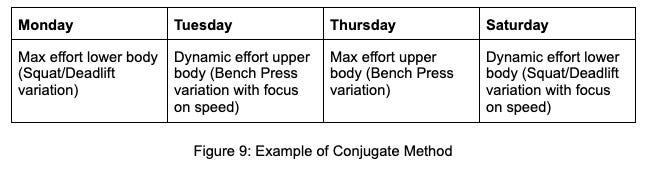
The Method: Popularized by Westside Barbell, this involves rotating “Max Effort” (lifting as heavy as possible) and “Dynamic Effort” (lifting fast with lighter weights) while constantly changing exercise variations (e.g., Box Squats vs. Back Squats).
Pros
Encourages constant adaptation
Can target specific weaknesses and sticking points
Requires a deep understanding of training principles
Addresses multiple aspects of strength and conditioning simultaneously
Cons
Not suitable for beginners
Time consuming and requires more equipment
Where to find Programs customized to your needs ?
Finding a workout program nowadays is very easy, but knowing the program will actually get you to your intended goal is harder than ever. Tools like ChatGPT can generate workout programs that seem like they are good enough on paper, but they often lack the intelligence built into them from experienced trainers. It’s also difficult to take a program template and then try and adapt it to your constraints. What if I really want to try the Intermediate PPL Double Progression program, but I have a knee injury ? The process of manually editing for your use case is frustrating. Luckily, we built an Agentic Program Builder tool that can customize the program just to you. It can even create a fully custom program from scratch as well, and you can just ask it to add your progressive overload system of choice !
Conclusion
Ultimately, progressive overload is only as complicated as you choose to make it. While it is easy to get lost in technical jargon, the biological reality remains refreshingly simple: your body adapts to the stress you consistently place upon it. You don’t need a “secret formula” or a PhD to see results; you just need a method you can stick to and a reliable way to track your wins.
Knowing the theory is one thing, but building a plan that actually fits your life is another. That is exactly why we created our Agentic Program Builder. Designed to act as your personal training architect, it bridges the gap between high-level theory and your actual workout on Monday morning. Whether you’re working around a nagging injury, training in a home gym with limited gear, or simply want to swap out a movement you dislike, our Agent handles the heavy lifting of logistics.
Just like a Personal Trainer, it applies sophisticated methods like Double Progression or Block Periodization directly to your specific constraints. Best of all, we believe you should have total control over how you train. Once your custom program is generated, you can seamlessly save and export it as a Spreadsheet or PDF, or sync it directly with your favorite tracking tools like Hevy, Strong, and MacroFactor Workouts. You get a professional-grade plan and the freedom to track your progress exactly where you want it.